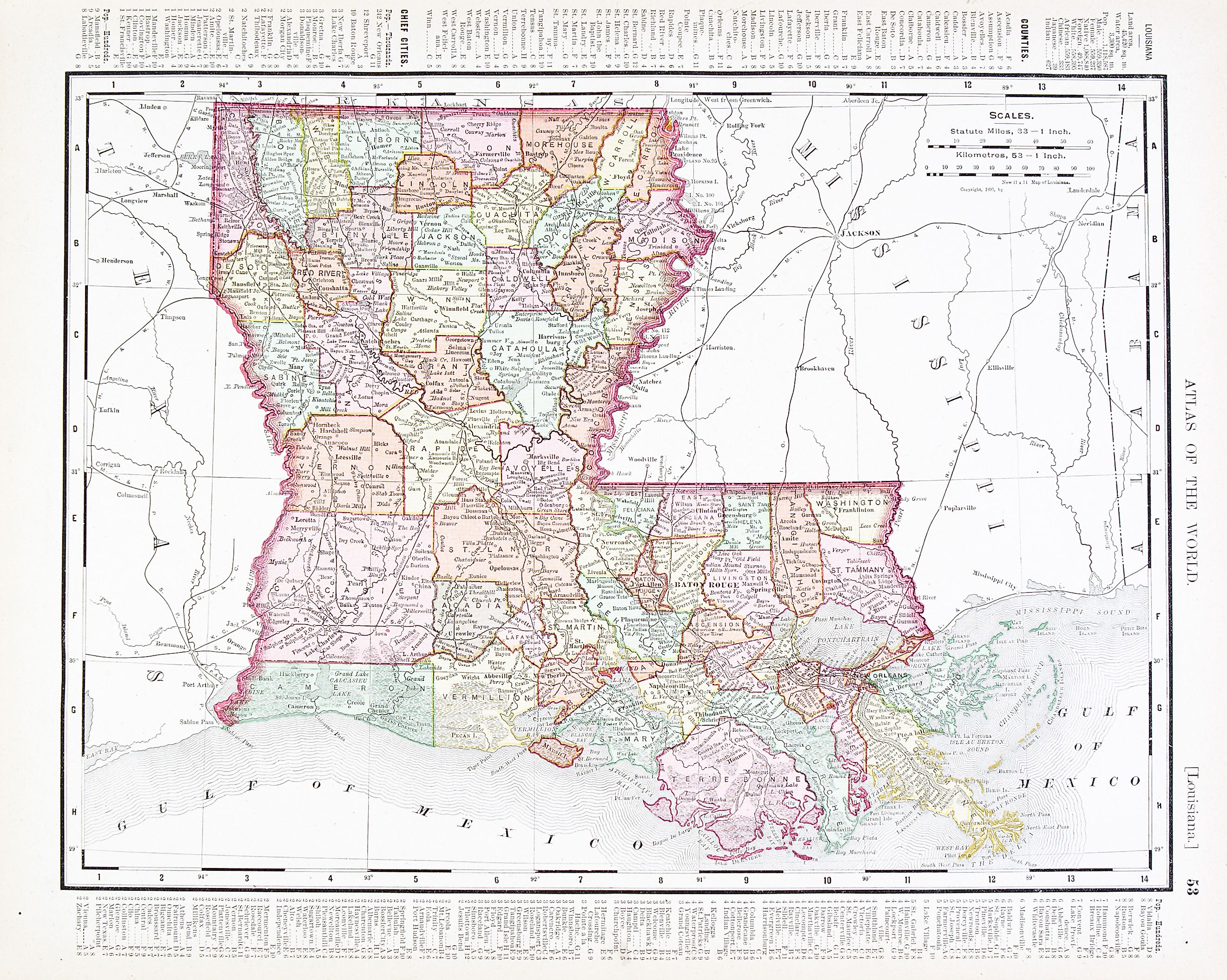
The Parishes of Louisiana
Louisiana’s map looks familiar at first glance, right up until the labels reveal something unexpected. Parishes replace the county lines seen in the rest of the country, creating a system found nowhere else in the Lower 48. The term has roots in colonial history, yet it remains part of everyday life across the state. The result is a patchwork of regions shaped by French and Spanish rule, Catholic tradition, Native cultures, waterways that steer settlement, and communities that formed long before statehood.
A look at these 64 parishes offers far more than a civics lesson. Each carries its own character, shaped by bayou landscapes, Gulf influences, prairie stretches, pine-covered hills, and historic towns that grew around trading posts, mission sites, and early agricultural centers. Together they create a statewide identity that is distinct, enduring, and tied to stories that reach beyond the typical county framework found elsewhere.
How Parishes Became Louisiana’s Foundation

Louisiana’s parish system traces its origins to a time when ecclesiastical boundaries set the tone for daily life. French and Spanish eras brought Roman Catholic traditions that organized communities around church parishes. These divisions shaped local rule before the United States ever entered the picture.
A major shift began in 1803 with the Louisiana Purchase. The Territory of Orleans soon needed a formal system of governance, and 12 large counties appeared in 1805. Their borders were poorly defined, yet they largely followed the outlines of existing church parishes.
A landmark moment arrived in 1807 when the territorial legislature created 19 civil parishes. This marked the beginning of the modern system, even though the word "county" continued to exist on paper until the Louisiana Constitution of 1845 officially replaced it. Expansion followed quickly during the early 1800s, adding new parishes as settlements matured, Native territories changed, and political alignments shifted.
By the time Louisiana reached statehood in 1812, 25 parishes filled the map. The number kept climbing as frontier regions were surveyed, plantations expanded, and river corridors drew new settlements. Reconstruction later brought another wave of parish creation in the late 1800s, introducing names such as Iberia, Tangipahoa, Grant, Cameron, and Lincoln.
The final additions arrived in the early 20th century. By 1912, the modern total of 64 had taken shape, with only minor boundary adjustments occurring afterward. Louisiana remains one of two states that avoided the county system altogether, placing it in rare civic territory.
Local Government Today

Modern parish government varies widely across Louisiana. Thirty-eight parishes operate under a police jury, a council that functions similarly to a county commission elsewhere in the country. The remaining parishes follow models such as council-president, consolidated city-parish governments, or appointed administrative structures.
Here is a breakdown:
Parish Government Types
-
Police Jury: 38 parishes
-
Council-President: Several mid sized parishes
-
Council-Manager: Select parishes, mostly in North Louisiana
-
Parish Commission: A small number of urban parishes
-
Consolidated City-Parish: Notable examples include Baton Rouge and New Orleans
This variety reflects Louisiana’s diverse geography, population patterns, and cultural differences. Local rule in a coastal region differs greatly from a pine-covered northern parish or the parishes surrounding the Mississippi River.
A Look at Louisiana’s Parishes

The full list of 64 parishes reveals the state’s layered history. Names highlight Native nations, saints, presidents, French phrases, and early American leaders. A few examples offer a glimpse into the range of stories spread across Louisiana:
Parish Highlights
-
Acadia Parish: Formed in 1886 and named for the Acadian culture that shaped south Louisiana. Crowley serves as the seat.
-
Caddo Parish: Created in 1838 and rooted in the heritage of the Caddo nation. Shreveport anchors the region.
-
Calcasieu Parish: Dating to 1840 with a name tied to Crying Eagle, an Atakapa leader. Lake Charles stands as its hub.
-
East Baton Rouge Parish: Originated in 1810 with a name drawn from a red pole used by Native groups to mark territory boundaries.
-
Jefferson Parish: Formed in 1825 and named for Thomas Jefferson. Today it stands as one of the most populous parishes.
-
Lafayette Parish: Created in 1823 and named for the Marquis de Lafayette. Its seat is a growing center of Cajun heritage.
-
Orleans Parish: Formed in 1807 and is coterminous with the City of New Orleans. Its cultural influence reaches far beyond Louisiana.
-
St. Tammany Parish: Established in 1810. Named after Chief Tamanend and home to rapidly growing communities north of Lake Pontchartrain.
-
Tangipahoa Parish: Created in 1869 with a name derived from an Acolapissa word meaning ear of corn.
-
Vermilion Parish: Formed in 1844 with ties to the Vermilion River and Vermilion Bay. Abbeville serves as its seat.
Tracing Parish Growth Across Two Centuries

Louisiana’s parish development occurred in major phases that mirrored political and cultural shifts.
Early Foundation: 1807 to 1820
The first 19 parishes were established in 1807. Shortly after, Catahoula joined in 1808. The Louisiana Purchase and territorial changes produced more additions in 1810. By 1812, the state entered the Union with 25 parishes.
Expansion Along Rivers and Settlements: 1820s to 1840s
New parishes emerged as communities expanded inland. Feliciana split into East and West. Jefferson Parish appeared in 1825. Claiborne arrived in 1830. A wave of additions in the late 1830s and early 1840s reflected settlement growth and shifting boundaries. Five parishes in a single year, 1843, signaled rapid expansion.
Pre Civil War Adjustments
The 1840s and 1850s added parishes such as Morehouse, Vermilion, Jackson, and Bienville. Parish lines stabilized slightly entering the Civil War era.
Reconstruction Era Growth
Reconstruction brought renewed political change. Parishes including Iberia, Richland, Tangipahoa, Grant, Cameron, Red River, Vernon, Webster, and Lincoln emerged between 1868 and 1873. These additions reshaped local governance and improved regional representation.
The Final Additions
Acadia appeared in 1886. LaSalle followed in 1908. Evangeline in 1910. Allen, Beauregard, and Jefferson Davis completed the parish map in 1912. Only modest boundary changes occurred afterward, including the 1979 division of Lake Pontchartrain among multiple parishes.
Why Parishes Still Matter in Louisiana

Parishes serve as more than civic borders. Each one defines identity for communities across the state. Music styles, food traditions, dialects, architectural patterns, and social ties often follow parish lines that trace back to colonial settlement patterns.
Historic parishes along the Mississippi River grew around early French and Spanish plantations. Coastal parishes shaped unique fishing cultures and maritime economies. Northern parishes developed closer ties to bordering southern states. Central parishes highlight a blend of frontier history and Native influence.
Parish governments also guide planning, education systems, emergency management, cultural preservation, and local decision making. Their authority extends across both rural areas and major population centers.
Parish Count by Period

This timeline highlights the layered nature of Louisiana’s map. Modern boundaries reflect more than two hundred years of social, political, and cultural evolution.
Parish Formation Timeline
-
1807 to 1812: 25 parishes
-
1820s to 1850s: Rapid expansion to more than 40
-
1868 to 1873: 9 Reconstruction era parishes added
-
1886 to 1912: Final expansion to 64
A Map Unlike Any Other

Louisiana’s parishes create a civic landscape filled with heritage, regional identity, and cultural depth. Each parish adds character to a state known for its music, cuisine, languages, festivals, and long history at the crossroads of continents. The modern map carries voices of French settlers, Spanish administrators, Native nations, frontier farmers, West Florida communities, American pioneers, and Reconstruction era leaders.
The parish system remains one of the clearest examples of how Louisiana protects and celebrates its unique identity. It also stands as a reminder that history still shapes daily life across the state.